
Dickens County Court Records After Arrest
Dickens County court records after arrest are not the same thing as a jail booking record. The Dickens County Sheriff's Office may confirm current custody at Dickens County Jail, and the jail side may identify an arresting agency, a booking date, a local hold, or a bond question. The court side begins when a charge is filed, pursued, amended, dismissed, or sent through a grand jury process. That path can involve the County Attorney, the 110th District Attorney, the Justice of the Peace, the District & County Clerk, county-level court functions, or the 110th District Court, depending on the charge and procedure.
That split matters in Dickens County because no official county-hosted jail roster was located. A reader checking custody should use the sheriff or VINELink channel described in Dickens County jail inmate records. A reader checking whether a booking photo exists should use the records request route described for Dickens County jail mugshots. Court records after a jail arrest answer a narrower question: what formal charge was filed, what court has the case, what the current case status is, and whether the result became a conviction.
Find Dickens County Court Records
The main online court access point in the research is the LGS Online Records Search linked by the Dickens County District & County Clerk. The LGS login screen shows an account path and a Guest Login button. Guest access matters because a person may need to check a charge before they have a cause number, lawyer, or notice from the clerk. Search results still need care. A booking allegation can be worded one way at the jail, while the prosecutor may later file a different offense level, reduce a charge, add a count, or decline to pursue a charge.
The LGS guest login page is the county-linked entry point shown in the manifest capture.
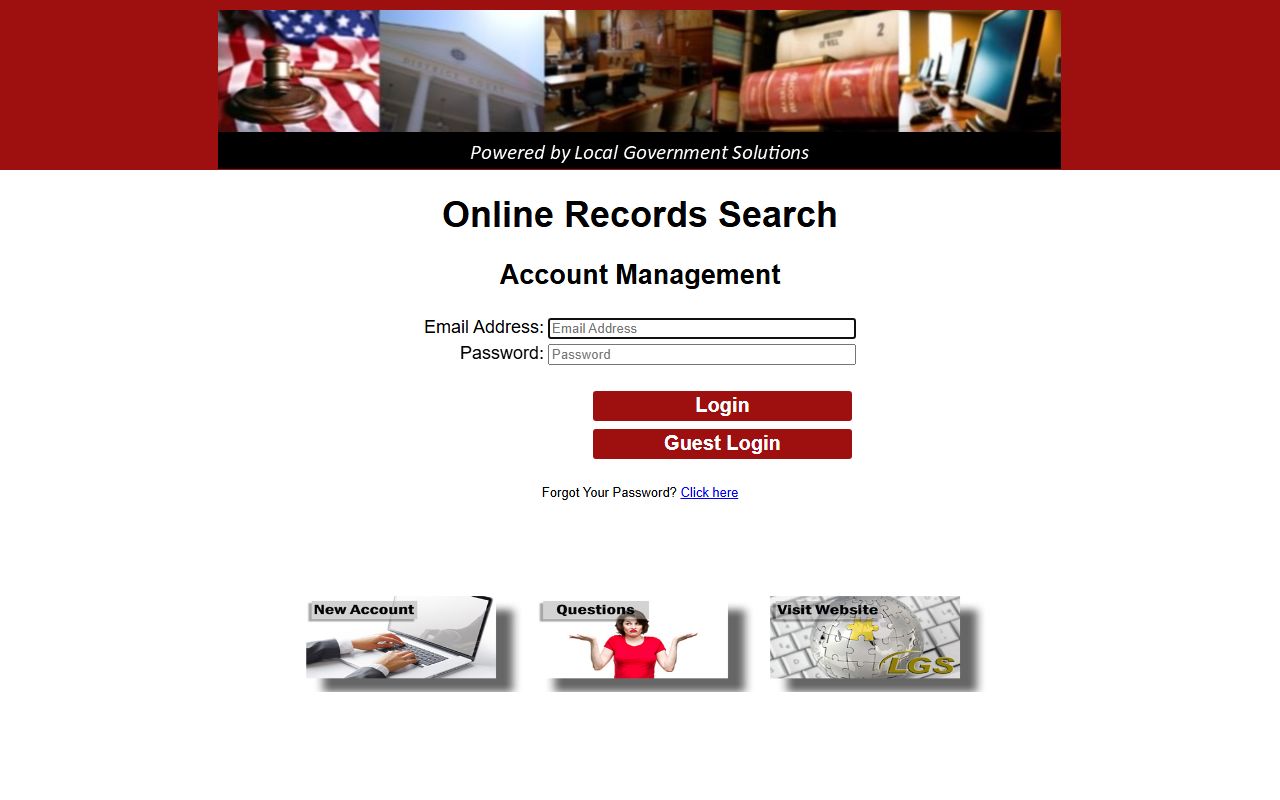
The guest login confirms that court-record searching is handled outside the sheriff's short jail page, so the best search starts with case information rather than mugshot or roster fields.
| Search item | How it helps | Dickens County note |
|---|---|---|
| Email Address | Used for an account login. | Guest Login may avoid an account for public search. |
| Password | Used with an LGS account. | Not needed if the public guest route works. |
| Guest Login | Starts the public path shown in LGS. | Use it before calling the clerk if no case number is known. |
| New Account | Registration path. | May be useful for repeat searches or fuller access. |
| Forgot Your Password? | Account recovery. | Not a case lookup field. |
Dickens County Arrest to Court Search
A solid Dickens County court-record search uses the arrest facts as clues, then checks the court file for the filed charge. Start with the person's full legal name, date of birth if known, arrest date, arresting agency, and any citation, warrant, cause, or booking number. If the LGS portal does not reveal the case, the District & County Clerk is the local records office to ask about case numbers and docket access. Clerk Danay Carnes is listed at the county clerk page with phone (806) 623-5531, physical address 508 Crow Street, Dickens, Texas, and mailing address P.O. Box 120.
- Confirm the arrest facts through the sheriff, VINELink, or a written public-information request if no online roster exists.
- Open LGS Online Records Search and try the Guest Login route before creating an account.
- Search by the defendant's name, then compare any case number, offense date, court, and charge wording.
- For Class C citation matters, check the Dickens County Justice of the Peace channel.
- For felonies, expect the 110th District Attorney and 110th District Court path to be more important than the jail record.
For a statewide conviction check after a case ends, the Texas DPS Criminal History Conviction Name Search is a separate DPS product. It is not a live Dickens County docket, not a jail custody search, and not proof that a recent arrest is still pending. It is most useful after disposition, when the question is whether a conviction record exists in the state criminal-history system.
Note: A jail booking charge is an early custody label, while the court record shows the charge the legal case is built on.
Dickens County Charging Documents
Formal court records after a Dickens County arrest often turn on the charging document. A complaint may start a lower-level case or support probable cause. An information is a prosecutor-filed accusation used in many Texas matters. An indictment is returned by a grand jury and is most associated with felony prosecution. The local path depends on offense level and procedure. The research identifies County Attorney Aaron Clements, Assistant County Attorney Robert S. Hogan, District Attorney Emily Teegardin, Judge Stella Carter in Justice Court, and Judge William P. "Bill" Smith in the 110th District Court structure.
| Document | Usual source | What to check |
|---|---|---|
| Complaint | Officer or prosecutor | Initial sworn allegation, citation matter, or support for case filing. |
| Information | Prosecutor | Filed charge, offense level, count number, and named defendant. |
| Indictment | Grand jury | Felony accusation, filed counts, court assignment, and later amendments. |
Do not treat the first charge heard at booking as the final word. A prosecutor can file fewer charges, add another count, change the grade, or decline the case. For Dickens County misdemeanors or county matters, the County Attorney page is the local prosecution source. For felony matters, the 110th District Attorney page lists Emily Teegardin's office in Floydada.
Dickens County Charge Status
Charge status describes where a filed case stands. Pending means the charge has not reached a final result. Amended means the filed wording changed. Reduced means the charge moved to a lower grade or different offense. Dismissed means that charge was ended by the court or prosecutor. These labels matter because a person may have been arrested, booked, and released, yet the formal Dickens County court records may still be pending or may show no conviction.
| Status | Meaning in a court record | Reader caution |
|---|---|---|
| Pending | The charge is unresolved. | Check later docket entries and bond conditions. |
| Amended | The filed charge text or count changed. | Compare the latest filing with the booking allegation. |
| Reduced | The case moved to a lower grade or different offense. | DPS conviction data may use the final offense, not the booking text. |
| Dismissed | The charge was ended without conviction on that count. | Dismissal is not the same as automatic expunction. |
| Convicted | A plea, verdict, or qualifying disposition created a conviction record. | Use court records and DPS for post-disposition checks. |
Bond After Dickens County Arrest
Texas bond law centers on Code of Criminal Procedure Article 15.17 and Chapter 17. After arrest, a magistrate informs the person of accusations and rights and addresses bail when bail is allowed. Dickens County does not publish local jail bond desk hours or payment methods, so bond details should be confirmed before anyone drives to the jail or courthouse. Call the sheriff for custody and bond status, then contact the clerk or Justice of the Peace for court-controlled payment questions if staff directs that route.
| Bond type | How it works | Dickens County action |
|---|---|---|
| Cash bond | Money paid to secure release. | Confirm amount, payee, hours, and place before arrival. |
| Surety bond | A licensed bondsman posts bond for a fee. | Ask whether a bondsman is allowed for each charge. |
| Personal bond | Release on promise to appear and follow conditions. | Only the court can confirm eligibility. |
| No-bond hold | Release is blocked by a court or holding agency. | Ask if parole, federal, ICE, or out-of-county holds exist. |
Dickens County Warrant Court Records
No official Dickens County sheriff active-warrant list was found in the research. Warrants therefore have to be checked through a practical chain: sheriff for custody or county warrant questions, Justice of the Peace for citation or bench-warrant matters, District & County Clerk for case and docket facts, and LGS for public case records that may be searchable. An arrest warrant is judge-authorized custody based on probable cause. A bench warrant or capias often follows failure to appear or failure to comply. A parole or blue warrant is a state hold and can keep a person in custody even if local bond is paid.
Dickens County Charge Comparisons
The most common mistake in reading Dickens County court records after a jail arrest is treating every public entry as a conviction. An arrest is a custody event. A charge is an accusation filed or pursued in court. A conviction is a later result based on a plea, verdict, or other qualifying disposition. The difference affects job checks, housing checks, license questions, and record-clearing questions.
| Point | Charge | Conviction |
|---|---|---|
| Stage | Filed accusation after arrest. | Final or qualifying court result. |
| Proof level | Based on accusation and court filing. | Based on plea, verdict, or adjudication process. |
| DPS role | Not the same as a conviction search result. | May appear in DPS conviction history. |
Texas record clearing has another distinction. Sealing limits public access to a record. Expunction under Texas Code of Criminal Procedure Chapter 55 can require eligible arrest records to be destroyed or treated as not having occurred. Eligibility is fact-specific. Dismissal, acquittal, non-prosecution, mistaken identity, and other outcomes may raise questions for a lawyer or the court, but they do not make a public jail or court record vanish on their own.
| Point | Sealed | Expunged |
|---|---|---|
| Public access | Restricted from many public searches. | Removed or destroyed under a court order when eligible. |
| Law enforcement access | May remain available for limited official use. | Very limited after proper order and notice. |
| Best next step | Review the court order and clerk record. | Use the Chapter 55 court process, not a mugshot removal request. |
Note: A dismissed charge may still have a visible case entry unless a separate sealing or expunction order applies.
Restricted Dickens County Court Records
Texas public access starts with Government Code Chapter 552, the Texas Public Information Act, but access is not unlimited. Juvenile records, medical or mental-health details, victim information, confidential law-enforcement material, active-investigation material, and security-sensitive jail information may be withheld or redacted. Dickens County's Public Information Act form asks whether the requestor agrees to redaction of mandatory and discretionary exceptions when clearly labeled, which shows that redaction is part of the local process.
Important: Court and jail records must not be used for credit, employment, insurance, housing, or other FCRA-covered screening.